
by Jerome Gabriel, Ed. D., Facility Supervisor of Four Rivers Environmental Education Center in Channahon, Illinois
While Benjamin Franklin said that nothing is certain except death and taxes, the ancient Greek philosopher Heraclitus is credited with teaching us, even earlier, that the only constant is change.
As leaders, our teams will inevitably change. You may have a longtime staff member retire, and hire someone new, or a reorganization happens, and you’re now faced with an entirely new team. Change happens, especially within groups working together, and how you lead through that change can be crucial to success in the future.
The effect of change doesn’t happen in a vacuum. We don’t just wake up one day and decide, now that things have changed, the world is right again, and we can move on with our goals. No, change has an impact on people, and as a team goes through change, there are some concrete steps that you can see if you know what to look for.
Stages of Group Development
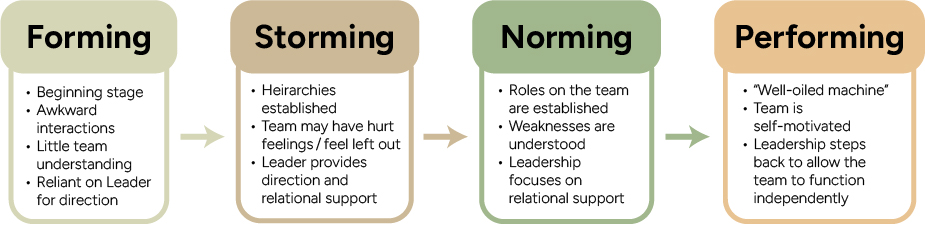
Sixty years ago, Bruce Tuckman introduced the world to his model of group development (1965). He argued that, given enough time spent together, a group of people will go through four recognizable stages.
I learned about this model early in my outdoor leadership career, and spent years on week-long backpacking and canoeing trips watching these stages unfold right in front of me. Seeing these stages happen so often, I was able to pinpoint when groups would flip to the next stage (and even when they’d sometimes regress). Watching a group move from burning water together while cooking to nearly gourmet campfire meals was always a welcome sight.
Moving into a supervisory role, I continued to see these changes, but at a slower rate. The days in the nature center weren’t nearly as intense as the days out on the trail, so the development came along more slowly. What could happen in days paddling down a river and sleeping under the stars would take weeks or months sitting at desks. But, and most importantly, it still happened. Knowing what to look for and identifying the changes in your team is an important first step in knowing how to lead them well.
Forming
The first stage that Tuckman identified was the forming stage. This is the beginning, the first steps of a new team. Like a baby’s first steps, they can be awkward. Team members don’t necessarily know how to interact with one another. They don’t know each other’s strengths and weaknesses, or how they work best. The team here is heavily reliant on the leader for direction and will often look to that person. The leader’s role here is simple: give direction. Being friendly and welcoming is great, but a new team (even if it's just one member) needs structure.
As they spend more time together and work alongside one another, they’ll start to enter the second stage. How will you recognize that transition? Don’t worry… you’ll know.
Storming
The storming stage can be the most challenging for a leader. At this stage, group members will begin to create internal hierarchies. As they learn about each other's skills and abilities, these “pecking orders” will begin to take shape. They may be social (most outgoing to least), or they might be technical (most highly skilled to least).
During these sometimes turbulent times, members of the group may feel left out or their abilities downplayed by other members. As a leader, seeing this change is important, as this team will still need direction to keep them on track, but now they will need some relational support too. Having one-on-one check-ins, some team bonding activities, or shared projects with everyone having a role can help the team navigate this stage.
Norming
Take a deep breath. You made it. The dust has settled, and your team has now accepted (or is near to) their roles and respects each member’s skills and abilities. Most importantly, they are now learning to leverage those skills to shore up weaknesses the team might have. As they learn to work together more efficiently, they will develop more of their own direction and need less from you.
In this stage, there may still linger some hurt feelings or other emotions from navigating the storm. So, while you may be lessening the direction you’re giving, you still are providing the relational support the team needs to fully develop those bonds.
Performing
Ah…the well-oiled machine. Your team can now accomplish anything. Give yourself a pat on the back for your great leadership. They work well together, solve problems, and no longer need you.
Wait…what? Yes, that’s right. As the team develops into the final stage, they now have a strong relational bond and provide much of their own direction. You are still part of the equation, but the team can function independently, too.
If the storming stage is the most challenging for a leader, the performing stage is a close second. Here, you need to take a step back and allow the team to accomplish things without your direct intervention. Choosing to remain as involved as you were in the early stages can lead the team to feel micromanaged or undervalued.
These stages, while generally linear, can see some back-and-forth movement when situations change. A storming team that is presented with an emergency? Back to forming and being reliant on a leader for direction. A performing team given an overly challenging project that might be beyond their scope? Probably going to lead back to some storming. Regardless, recognizing the stages is essential for a leader, as your approach to the team needs to differ at each stage.
Leadership within the Stages
The model of these stages is helpful to understand group dynamics, but what does the leadership really look like at each stage? There are hundreds of leadership models and theories out there to choose from, which do you use?
While not all leadership experts might agree with me, I choose to believe the best approach is responding to the situation you are presented with, rather than choosing a particular model. Luckily, just a few years after Tuckman produced his model, Kenneth Blanchard and Paul Hersey (1970) defined Situational Leadership as an approach we can take.
Situational Leadership
At its core, Situational Leadership is pretty simple. Your leadership consists of two factors: the amount of direction you give and the amount of relational support you provide.
Some situations call for a leader to provide a lot of direction and little relational support, such as a medical emergency. Other times, a leader may need to provide a lot of relational support but very little direction, such as consoling a team member who has lost a loved one. In between, a leader will find a need to balance one, another, or both. In all situations, it’s the same leader, but the behavior differs greatly.
To make the discussion a little simpler, Blanchard and Hersey named each of the variations of this leadership. High directional and low relational leadership is referred to as Directing. As you maintain a lot of directional leadership and increase the relational support you provide, you’re now Coaching. If you continue to provide a lot of relational support, but back off on the direction, you’re now Supporting. And finally, if you reduce your interactions in both directions, now you’re Delegating.
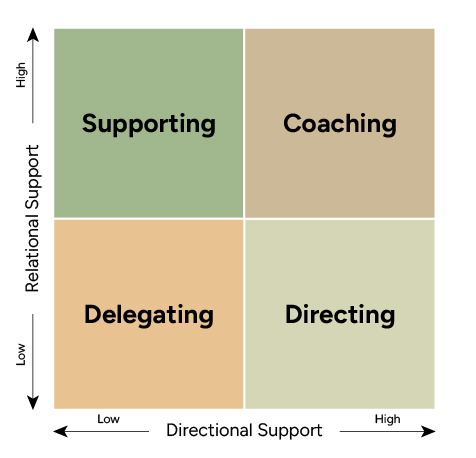
In any circumstance, this is a good approach to know. Look at your team. What do they need right now? A lot of direction or a lot of relational support? Both? None? It is a good tool to step back and use before jumping into your next meeting. But, I believe, where this idea really shines is when your team is going through change.
Combining it all
Imagine losing your most seasoned naturalist to retirement. All that institutional knowledge and easy understanding of how things have always been done is now being replaced by a new and eager face. The team looks different, lacks some skills, but has gained some new ones. Now, where do you go from here? This new team is starting at the beginning, and as the leader, you can too. Combining these two models gives us a roadmap for navigating the change together.
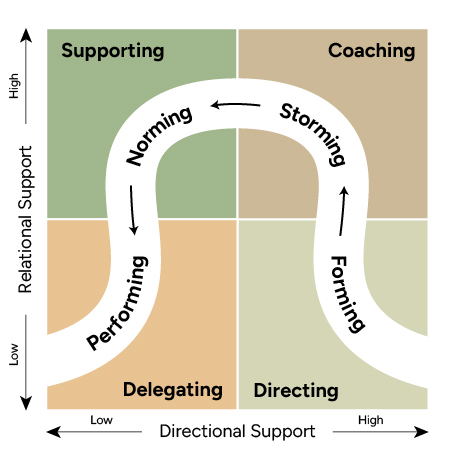
The eager new naturalist jumps in headfirst, but quickly finds themself struggling. Provide them with some direction, assign a program, and assign a mentor to help them. You don’t need to develop a strong relationship with the new staff member or help them build relationships with the team at this point. Instead, they really need to understand the day-to-day tasks and get a handle on their new responsibilities.
As the team spends time together, everyone becomes aware of the new skills your new team member brings, but it also becomes more apparent what they have lost. The new staff member may feel they aren’t meeting others' expectations, or perhaps feel disconnected from a team that has worked together for many years.
Here, your leadership needs to move to coaching and help build those relationships while still recognizing that a lot of direction is needed for this new staff member and the reformed team. While teambuilding activities might get an eyeroll from some, they are effective in creating shared experiences. If leading these types of activities isn’t your thing, plan a team hike, paddle, or other activity not associated with the day-to-day job to allow a focus on relationships over work.
After a time, the new team member is proficient in the role and produces well alongside other members of the team. While this is a good time to back off your direction (no one likes to be micromanaged forever), this new staff member and the team still will need a push every now and then. A supporting role means taking some time to meet with your team members one-on-one. How are they feeling about the transition? What new ideas have a fresh perspective offered? What can you do to help support them? Take time to listen and not to offer your thoughts. This can give you a roadmap to understand what the team needs and where they are really at in their development.
Finally, after a few months (or years – there’s no timeframe on this process), the team works well. They recognize each other's strengths, provide support to bolster each other’s weaknesses, and develop some new programming ideas you never would have considered. This is the hardest part, you step back and simply direct. You allow them to take on bigger challenges and encourage them to come to you with questions. You’ll ask about the resources needed or other support, but you are willing to let them both succeed and fail on their own.
Just remember, as nice as it is to think of this process as linear, people change, situations change, and each time, your leadership should change with it. An unexpected leave of absence might send the team back to storming and require more coaching. Or a team starting to understand its roles may be presented with an easy program opportunity, where you’ll completely step back and just direct. It’s an incredibly hard balancing act to know when to step in and when to step back. And, just like the skills your new naturalist is learning, you’re working to develop your skills too.
Moving Forward
No leadership theory is perfect, and some may find certain theories more effective than others. The combination of these two models has been my go-to from guiding in the Rockies, to teaching in the classroom, and now into the nature center administration. Even if this leadership approach doesn’t fit you, I hope that it opens up a new perspective in thinking about how to lead your staff. Consider yourself, your staff, and also the situation. What does each need right now, and what can you do to guide things toward the best outcome?
Advertisements